Air receiver
Storage sized around demand peaks and compressor control.
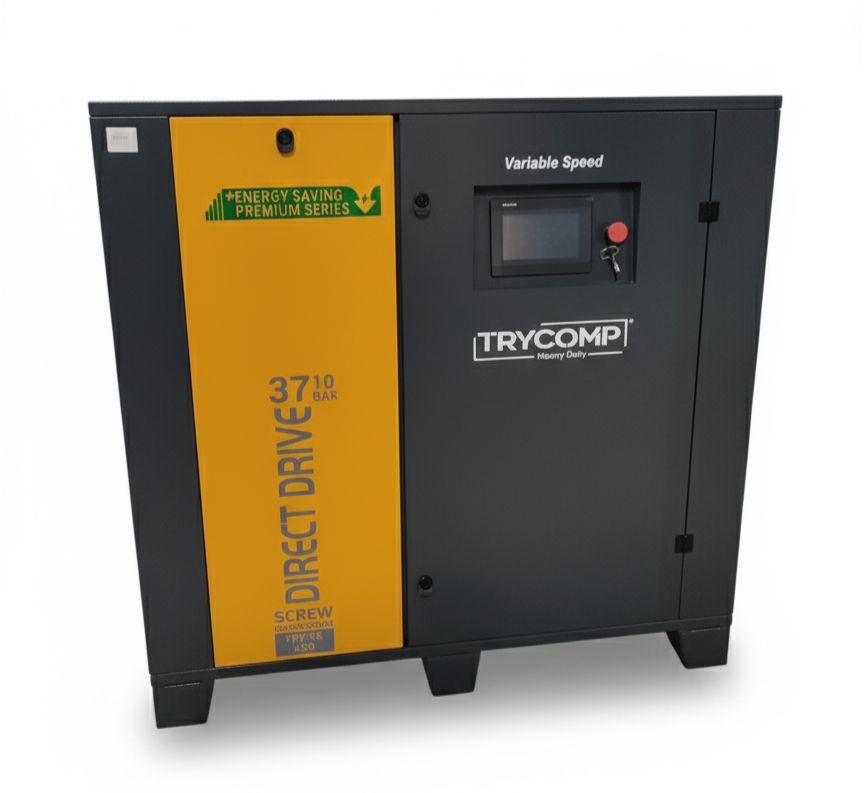
TryComp rotary screw compressor
Mid-sized production plants and higher-flow workshops. Designed for continuous-duty industrial compressed air, with fixed-speed and VSD configurations available to suit the demand profile.
Application guide
This size is commonly considered for packaging lines, fabrication plants and central air systems. Suitable for consistent production loads and planned multi-shift operation.
Fixed speed: Suitable for consistent production loads and planned multi-shift operation.
Variable speed: Improves control when demand varies across departments or shifts.
Available package components
Storage sized around demand peaks and compressor control.
Moisture control matched to the flow and operating conditions.
Pre- and after-filtration selected for the required air quality.
Electrical coordination, ventilation, drainage and air piping.
Talk to a compressor specialist
Send us your current compressor details, required pressure and application. We’ll help you choose the right next step.
Practical answers
These answers cover common planning questions. Final recommendations are confirmed from the machine data and site conditions.
Compressors with the same motor power can deliver different airflow at different pressures. Selection should use the manufacturer’s FAD at the required working pressure.
VSD is most useful where air demand varies meaningfully. A stable base load may be better served by fixed speed, or by a correctly sequenced combination of machines.
A complete system may include the compressor, air receiver, refrigerated dryer, filtration, condensate management, electrical coordination, ventilation and distribution piping.
Receiver sizing depends on compressor control, demand peaks, acceptable pressure variation and the application. It should be calculated rather than chosen only from motor size.
Confirm FAD, working pressure, power supply, ambient conditions, operating hours, air-quality requirement, installation access and future demand.
Intervals depend on the manufacturer, operating hours and site conditions. Dust, heat and heavy duty can justify closer inspection even before the scheduled service hours are reached.